
Investment Insights: Iran, Oil, and Your Investments
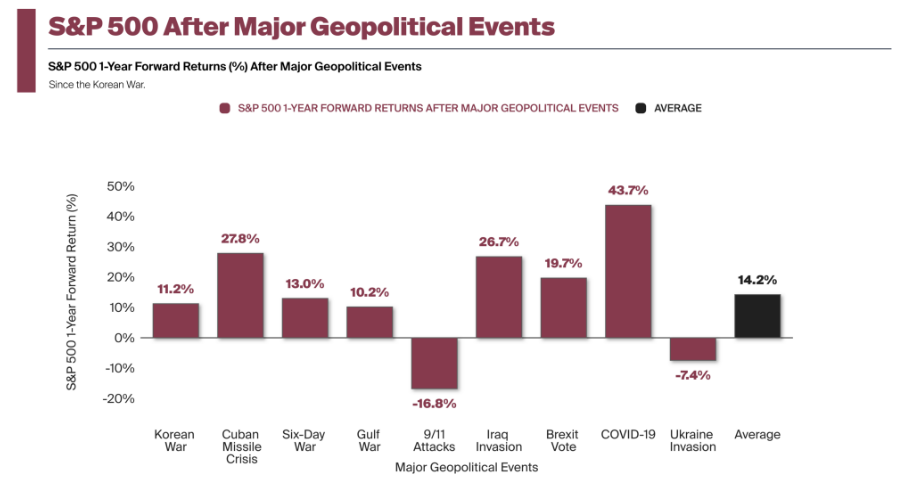
If you've been following the news recently, you'll know that the world feels unsettled. US and Israeli strikes on Iran began on 28 February, oil prices have surged 38% year to date, and there is heightened anxiety across global markets. I've had a number of clients reach out asking how to think about this.
Markets have been relatively resilient so far but at times like this volatility can be expected to increase significantly. There is concern around oil supply, specifically that ships are currently unwilling to pass through the Strait of Hormuz, through which around 20% of the world's oil moves. The uncertainty is real, and nobody can tell you it is nothing. But there is an important difference between short term impact in markets and what actually happens to your portfolio over the next 5 or 10 years.
Short Term News and Long Term Outcomes
In March 2020. COVID-19 was spreading fast, borders were closing, and markets fell around 35% in a matter of weeks. Many investors moved to cash. Nobody rang a bell at the bottom of the market, and many of those investors missed one of the fastest recoveries in market history.
In April 2025. Trump's tariff announcements triggered a sharp sell-off, around 16% at its worst. Recession fears, trade war headlines, global uncertainty. Again, nobody rang a bell to say it is safe to get back in the market, but markets came back to all time highs and beyond.
Fears and uncertainty you felt during COVID are having no impact on your portfolio balance today. The current newsflow, as serious as it is, is very unlikely to be relevant to where your portfolio sits in 5 or 10 years from now. That is not wishful thinking. It is what history tells us, time and again.
Investment writer Ben Carlson published a timely piece on this just days ago, which I'd encourage you to read: https://awealthofcommonsense.com/2026/03/geopolitics-vs-markets/
A couple of things from it stand out:
During the two worst wars in modern history, World War I and World War II, the US stock market was up a combined 115%. Not despite the wars. During them.
Pearl Harbor sent markets down 2.9%. They recovered within a month.
The Dow barely noticed D-Day.
Carlson also admits he has no idea how long this conflict will last. Nobody does. But the history of what markets did next is worth understanding.
The Danger of Reacting
When markets fall and the news is alarming, the instinct to do something feels completely rational. Move to cash. Wait for things to settle. It feels like protecting yourself.
But this instinct goes back a long way. The person who ran towards the rustling in the bush thousands of years ago did not survive. We are wired to avoid danger, to act, to move. That instinct served us well on the savanna. It does not serve us well as investors.
To time the market successfully, you don't just have to get out at the right moment. You also have to get back in at the right moment. In practice, people who exit during a crisis tend to wait until things feel calmer before returning. By the time things feel calmer, the recovery has already happened. They lock in a loss and miss the rebound.
And if someone exits and it happens to work out, they don't learn they got lucky. They learn they are good at this. So they do it again. And again. Until eventually they get it badly wrong. Weaving in and out of markets is not a refined version of your investment strategy. Over time, it destroys long term wealth.
When uncertainty rises, it is worth taking a moment to reflect on what you actually own and why.
Are you invested in a small number of concentrated positions, or are you spread across a broad range of assets and geographies?
Are your investments chasing the highest possible return, or are they following a disciplined, evidence based process with a long track record?
Are you speculating, or are you invested in good quality funds that have navigated many crises before and come out the other side?
If your honest answers reassure you, then you already know what to do right now. Which is very little.
It is worth noting that even well constructed, diversified funds experience short term losses. That is not a sign that something has gone wrong. It is a feature of your investments, not a bug! The goal is not to be protected from every short term fall. It is to be invested in something robust enough that you do not need to abandon it when those falls happen.
What to Do Now
Counterintuitively, very little. Stay invested. Keep making contributions if you were already doing so. If uncertainty is intolerable, we should consider your asset allocation and for example reassess if you are a balanced investor instead of growth.
What is happening in the Middle East is serious and it will continue to create short term volatility. But it does not change the case for staying invested in a portfolio aligned to your goals and timeframe. The investors who come out of this in the best position will not be the ones who timed it. They will be the ones who picked a proven process and stuck with it.
As always, if you have questions about your specific situation, please get in touch.