
If you’ve seen the news lately, you’ll know markets have been falling. The US share market (the S&P 500) is down about 12% from its high in early October, and there’s a bit of pessimism around right now. Here’s what’s behind it.
What’s driving it
It’s a combination of things. The biggest catalyst has been Nvidia, which makes the chips behind most of the AI boom and has grown so large it makes up a big slice of the S&P 500 on its own. Earlier this month its founder and chief executive, Jensen Huang, resigned following a scandal and a board investigation. The fall in Nvidia then spread to other AI and technology companies, which were already facing questions about how much they’re spending and borrowing.
The second is interest rates. US inflation has picked up again, the Federal Reserve raised rates in September, and markets expect another rise in December. Higher rates make borrowing more expensive and term deposits more attractive, which tends to weigh on share prices.
On top of that, Anthropic (the company behind the AI tool Claude) listed last week in the biggest share float in history, raising more than US$80 billion. That money has to come from somewhere, and some of it has come from investors selling shares they already own, particularly in other technology companies.
Some perspective
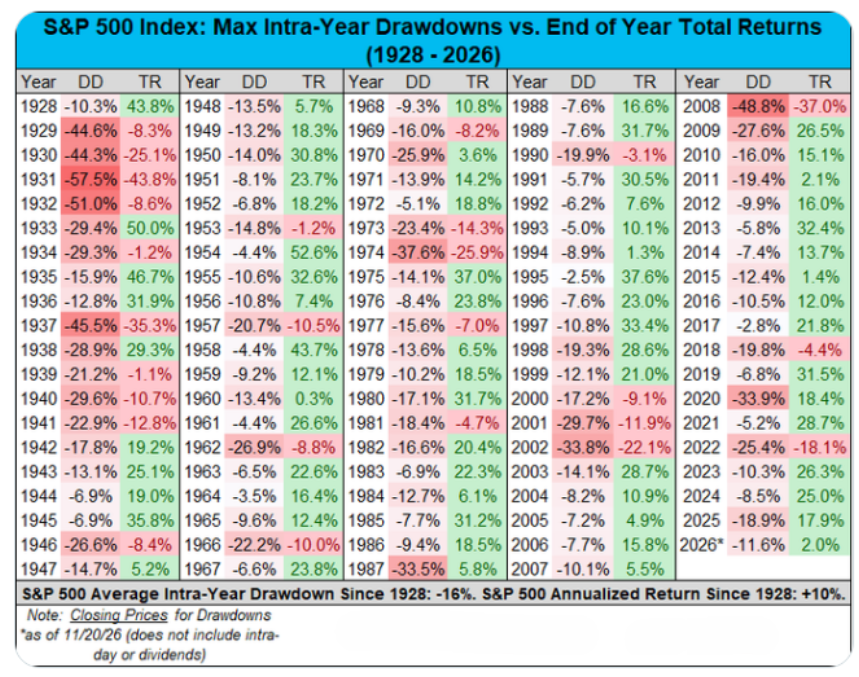
This chart shows every year since 1928. The red number is the biggest fall the market had during the year, and the mostly green numbers (TR) are where the year finished. The average fall per year is 16%, while the market returned 10% a year over the whole period.
Last year, during the tariff scare in April, the market was down nearly 19%, and it still finished the year up almost 18%.
Peter Lynch, one of the best known fund managers of all time, put it simply:
“About once every two years the market falls 10%. Every six years the market’s going to have a 25% decline. That’s all you need to know. You need to know that the market’s going to go down sometimes. If you’re not ready for that, you shouldn’t own stocks.”
Built for this
This is why we choose funds in advance that are more resilient during the bad months and years, because we know the bad months and years will come. Otherwise we would just chase maximum upside in the good times. Being resilient in the bad times can help portfolio returns, and it makes it much easier to stay invested.
At the start of this fall, Nvidia made up about 8.5% of the S&P 500, but only around 4% of Dimensional funds. That’s because Dimensional doesn’t decide how much to hold in a company based on its size. It looks at how profitable a company is and how cheap its shares are. The result is that Dimensional can lag a little in the good times, but it tends to hold up significantly better when markets fall.
Berkshire Hathaway is another example. It rose about 4% during the tariff scare last April, and it’s up about 4% over the last month too. It has outperformed the market over the long run by being more resilient, not by being more spectacular.
How I personally feel about this correction
I don’t love it! As humans we just want to see our money go up, every day and every month. But if it worked like that we’d have chaos. People would be borrowing to invest and trying to double their money every 6 months, and we’d get boom and bust on a scale nobody wants.
So while I don’t love it, a correction never makes me change strategy, question anything or lose sleep. Over decades of investing I’ve learnt not to overreact to news. The more active you are, the more you tend to destroy your returns. The hard work is done before the fall, by choosing investments you understand and can live with in the first place. We know the falls Peter Lynch talks about are coming, so we invest to ride through them, not to guarantee a profit. As investors you get rewarded by accepting the ups and downs that come with the market. Effectively being rewarded for doing the things that others can’t which is being patient, disciplined and rational.
What this means for you
Reacting to news flow, brings more risk, not less. We never know when markets will bounce back. But history tells us they eventually do, and greed is closer to fear than you’d think. While the headlines are at their worst, there are professional investors with a lot of money deciding not whether to buy, but when, and that’s often why the sharpest bounces come straight after the worst falls.
Historically, missing just the 10 best days over a 10 year period has roughly halved investors’ total returns. Selling out means having to guess when to get back in, and risking missing exactly the days that matter most. Staying invested is how you make sure you’re there for the new all time highs when they come.
As always, if you’d like to talk any of this through, get in touch.