
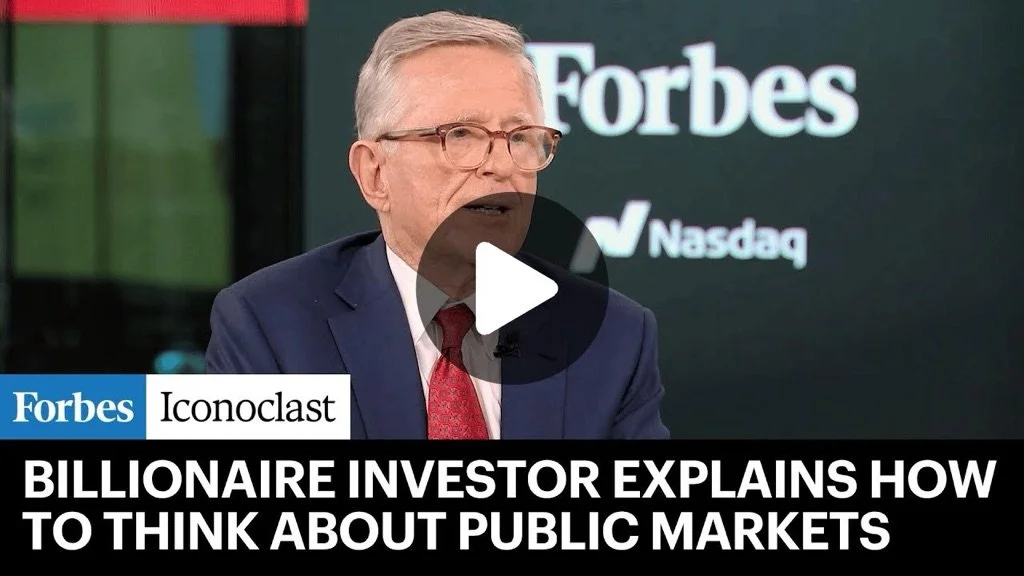
David Booth, the founder of Dimensional Fund Advisors, gave an interview recently that is worth your time. I've shared it below. If you don't have half an hour spare to watch the whole thing, here are the points he makes and why they matter for the way we invest.
It all comes back to one idea. The job is not to remove uncertainty from your financial life. It is to manage it. Most of us spend a lot of energy trying to make the future feel certain, and Booth's view is that this is the wrong goal. Quietly chasing it costs you money.
Start with the uncomfortable part. Uncertainty is not the enemy of returns. It is the source of them. The closest thing to a certain return is a government bond, and that safety is exactly why it pays so little. If every investment were that predictable, they would all pay the same low return and nothing more, because none of them would be asking you to carry any risk. The higher expected return from shares, and the higher return they have actually delivered over time, is the return for living with uncertainty.
Booth makes the same point about life outside markets. If your path were mapped out with no surprises, there would be no room to grow. Progress and returns both live in the space where we cannot see exactly what happens next. When he was asked what he still holds deep conviction in after a lifetime in the business, he did not reach for a clever tactic. He pointed to embracing uncertainty. Not tolerating it.
From there, a few practical points follow.
Plan, don't predict. Nobody can reliably call where markets go over the next month or the next year, and Booth does not try. A good plan is not a forecast. It is a set of sensible decisions made with the information you have now, built so you can adapt as things change. Forecasts make you feel in control. Plans actually keep you in control.
Trust human ingenuity. Over the last hundred years the stock market has returned roughly 10% a year, and Booth credits that to people solving problems. When companies hit a crisis, they work out how to get back on track. That problem solving, repeated across thousands of companies over decades, is what eventually shows up in your returns.
Stay in the market. Booth is blunt here. There are, in his words, no mulligans. No second chances. Miss a handful of the market's best days, usually the ones that arrive when things feel worst, and you may never make that growth back. The enemy is noise. He argues for tuning out the constant commentary and having the humility to accept that you are not going to beat the collective judgement of every other investor setting prices. Sitting still is not doing nothing. It is often the hardest and most valuable thing an investor does.
Do right by people. There is a story he keeps returning to from his first job selling shoes. The rule was simple. Don't sell shoes that don't fit. Plenty of the financial industry does the opposite, selling the product that pays the best commission rather than the one that suits the client. Booth built an entire firm on the boring version, and the trust compounds over the years.
Keep it scientific. Underneath all of it is a plain approach. Booth treats investing as financial science, not black magic. That means broadly diversified, low cost portfolios, with enough flexibility in how trades are done to add value rather than rigidly tracking an index. No hero bets. No secret formula. Just a well built structure that captures what markets give you and does not leak returns through cost and poor timing.
You make big decisions under uncertainty all the time, about work, family, where to live, without a crystal ball. Investing is the same skill applied to your money. The goal was never certainty. It was a plan good enough to hold, through the years when the future looks especially unclear.